The third webinar, held on April 21, 2026, focused on “Accounting for people, nature and the economy; the Ocean Accounts Framework," and provided several reflections from the speakers regarding the work being carried out on ocean accounts in their respective countries.
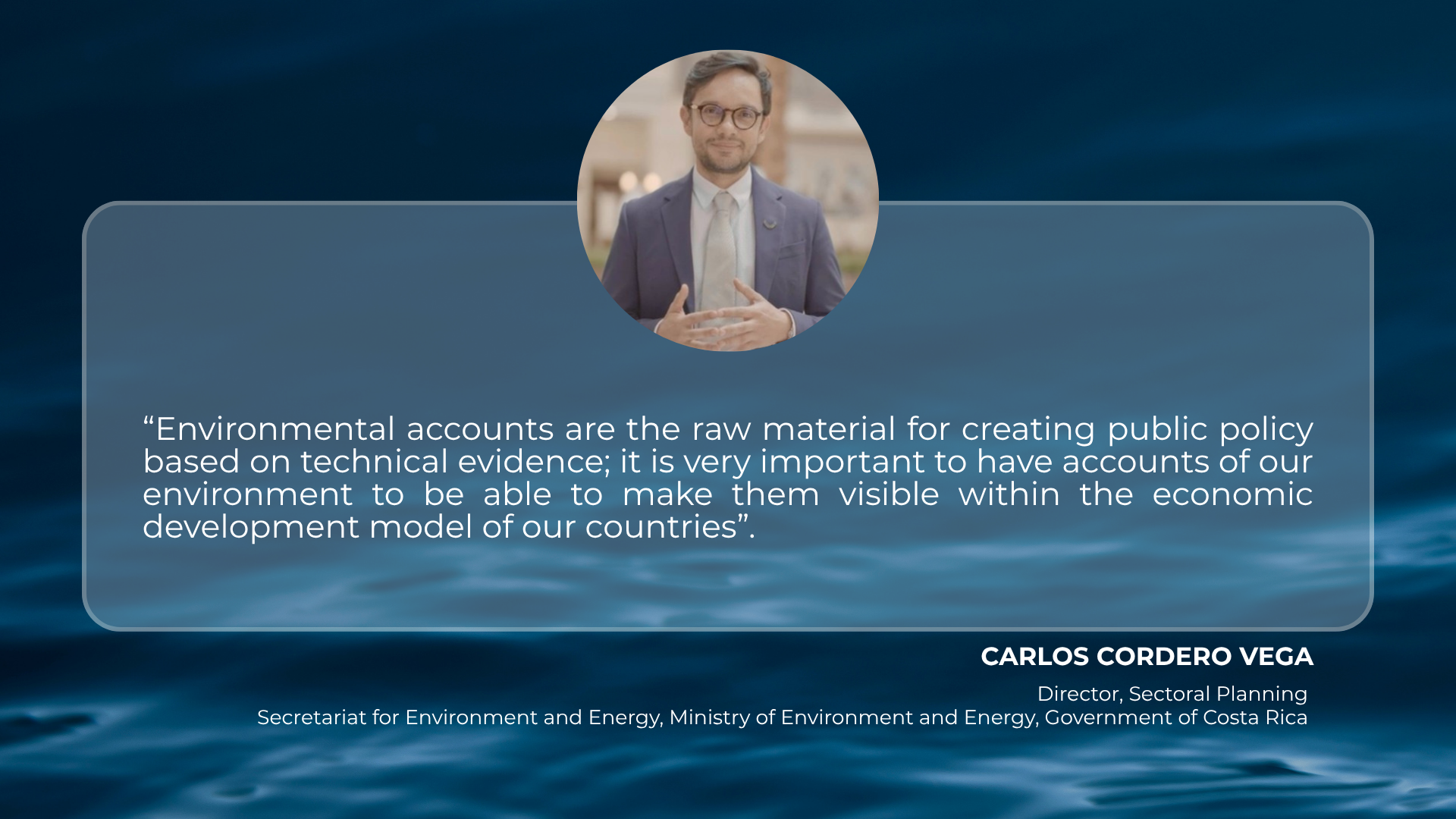
The webinar opened with a presentation by Mr. Carlos Cordero Vega, Director of the Sectoral Planning Secretariat for Environment and Energy at the Ministry of Environment and Energy of the Government of Costa Rica. During his intervention, he began by stating that: “Environmental accounts are the raw material for creating public policy based on technical evidence; it is very important to have accounts of our environment to be able to make them visible within the economic development model of our countries.” He explained that the country did not limit itself to calling them solely "ocean accounts"; instead, to better represent the full scope, they named them the Marine and Coastal Resources Account. He noted that “in 2024, at the Immersed in Change event, we started a pilot in Mangroves. By 2026, we already have a roadmap for the ocean account.”
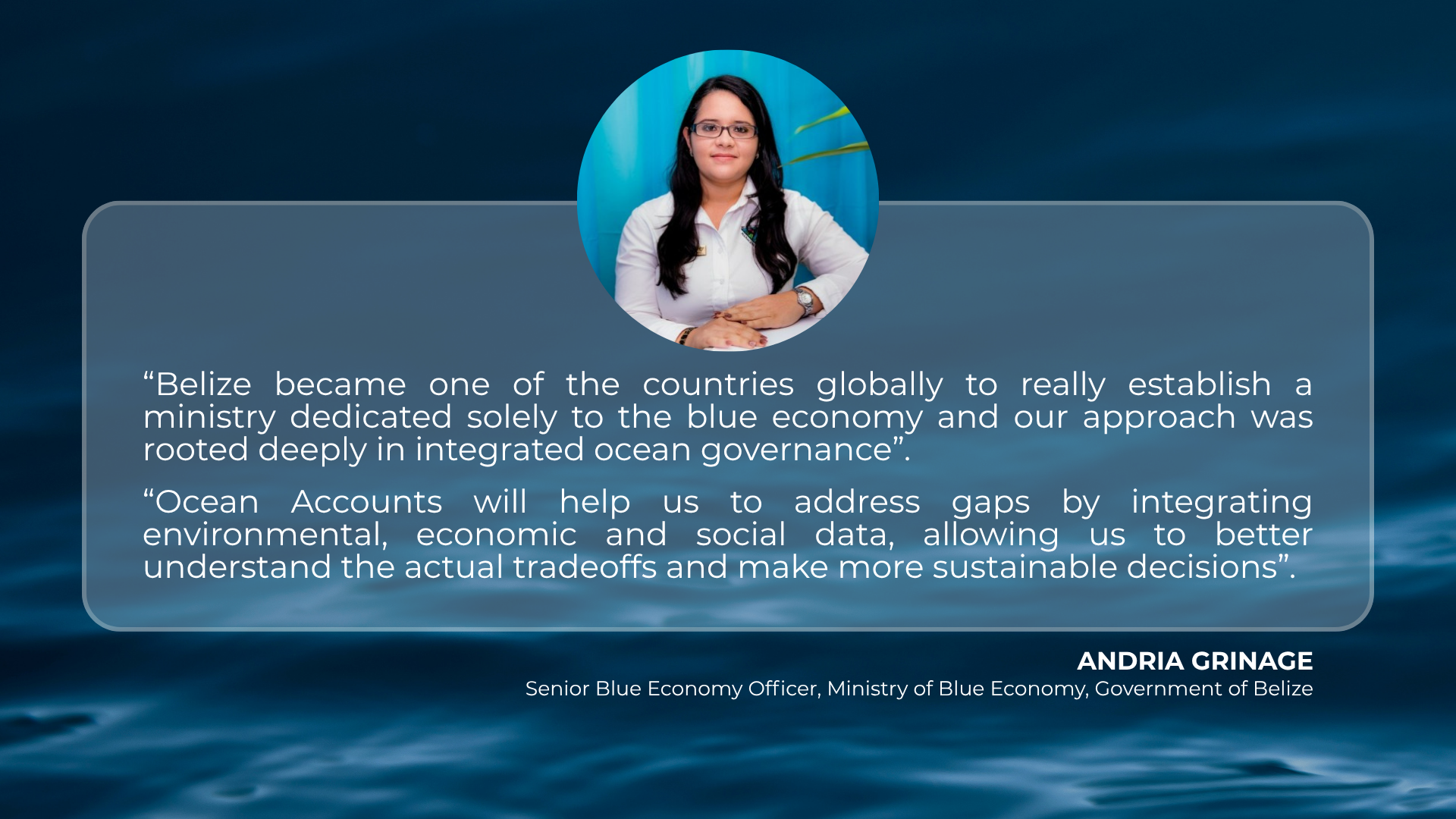
This was followed by the intervention of Andria Grinage, Senior Blue Economy Officer at the Ministry of Blue Economy and Marine Conservation, who explained that: “Belize became one of the countries globally to really establish a ministry dedicated solely to the blue economy and our approach was rooted deeply in integrated ocean governance.”
“Belize's economy is extremely connected to the ocean. Ocean Accounts will help us to address gaps by integrating environmental, economic and social data, allowing us to better understand the actual tradeoffs and make more sustainable decisions. Belize launched its Ocean Accounts Pilot Project in 2024 that will allow us to systematically measure how our ocean really contributes to our economy.” She finalized her intervention by stating that “the pilot allows the country to generate data on ecosystem health, economic activity and social benefits.”
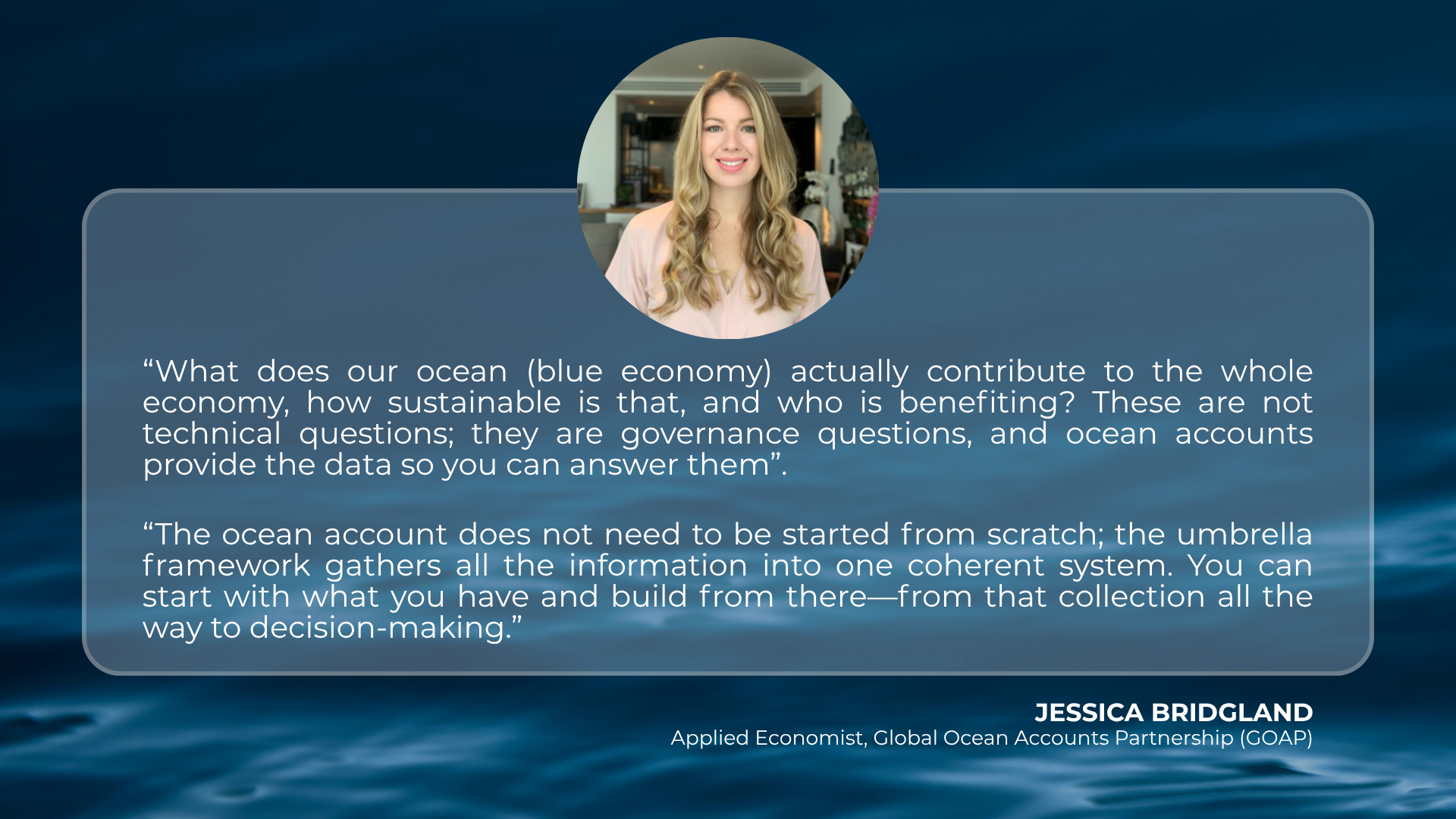
The webinar, held in partnership with the Global Ocean Accounts Partnership (GOAP), featured a presentation by Ms. Jessica Bridgerland, Applied Economist from GOAP. She began her intervention with three critical questions for governments that depend heavily on the ocean: “What does our ocean (blue economy) actually contribute to the whole economy, how sustainable is that, and who is benefiting? These are not technical questions; they are governance questions, and ocean accounts provide the data so you can answer them.”
She continued her intervention by stating that “the ocean account does not need to be started from scratch; the umbrella framework gathers all the information into one coherent system. You can start with what you have and build from there—from that collection all the way to decision-making.” These plans respond to local needs, and she emphasized that conservation is not a cost, but rather generates a significant return on investment. She concluded by highlighting several practical examples from different countries around the world that are implementing Ocean Accounts.
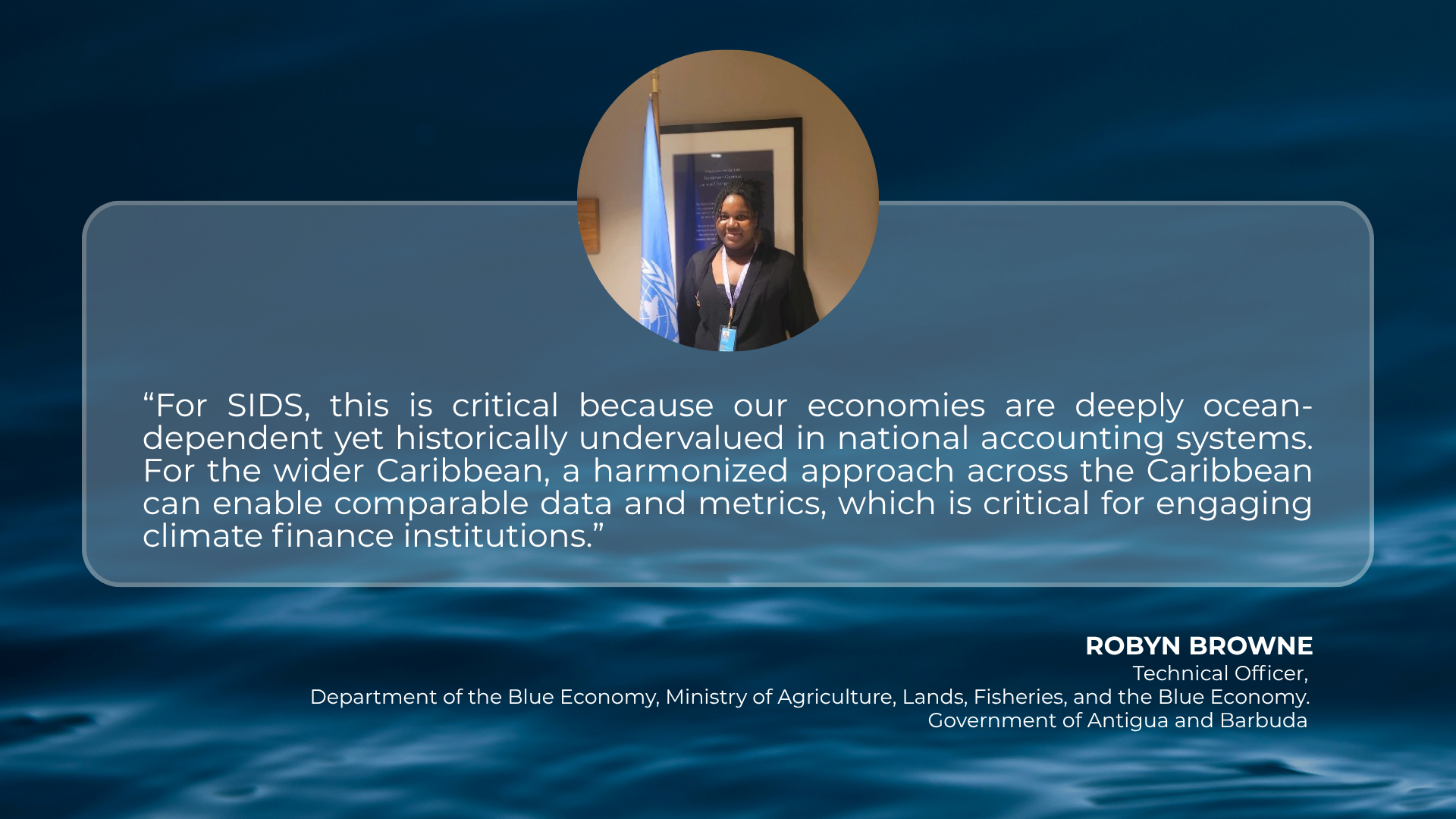
Recognizing that Antigua and Barbuda is a vocal advocate for Small Island Developing States (SIDS), Ms. Robyn Browne, Technical Officer at the Department of the Blue Economy, Ministry of Agriculture, Lands, Fisheries, and the Blue Economy for the Government of Antigua and Barbuda, addressed the question of how a harmonized or regional approach to ocean accounts in the wider Caribbean could empower islands to better negotiate climate finance and sustainable investment:
“For SIDS, this is critical because our economies are deeply ocean-dependent yet historically undervalued in national accounting systems. For the wider Caribbean, a harmonized approach across the Caribbean can enable comparable data and metrics, which is critical for engaging climate finance institutions.”
She concluded her intervention with an example: “Evaluating a coral reef, not just as biodiversity, but as a coastal protection infrastructure, could strengthen our cases for adaptation finance. Individual economies are small, but collectively represent significant and investable opportunities.”
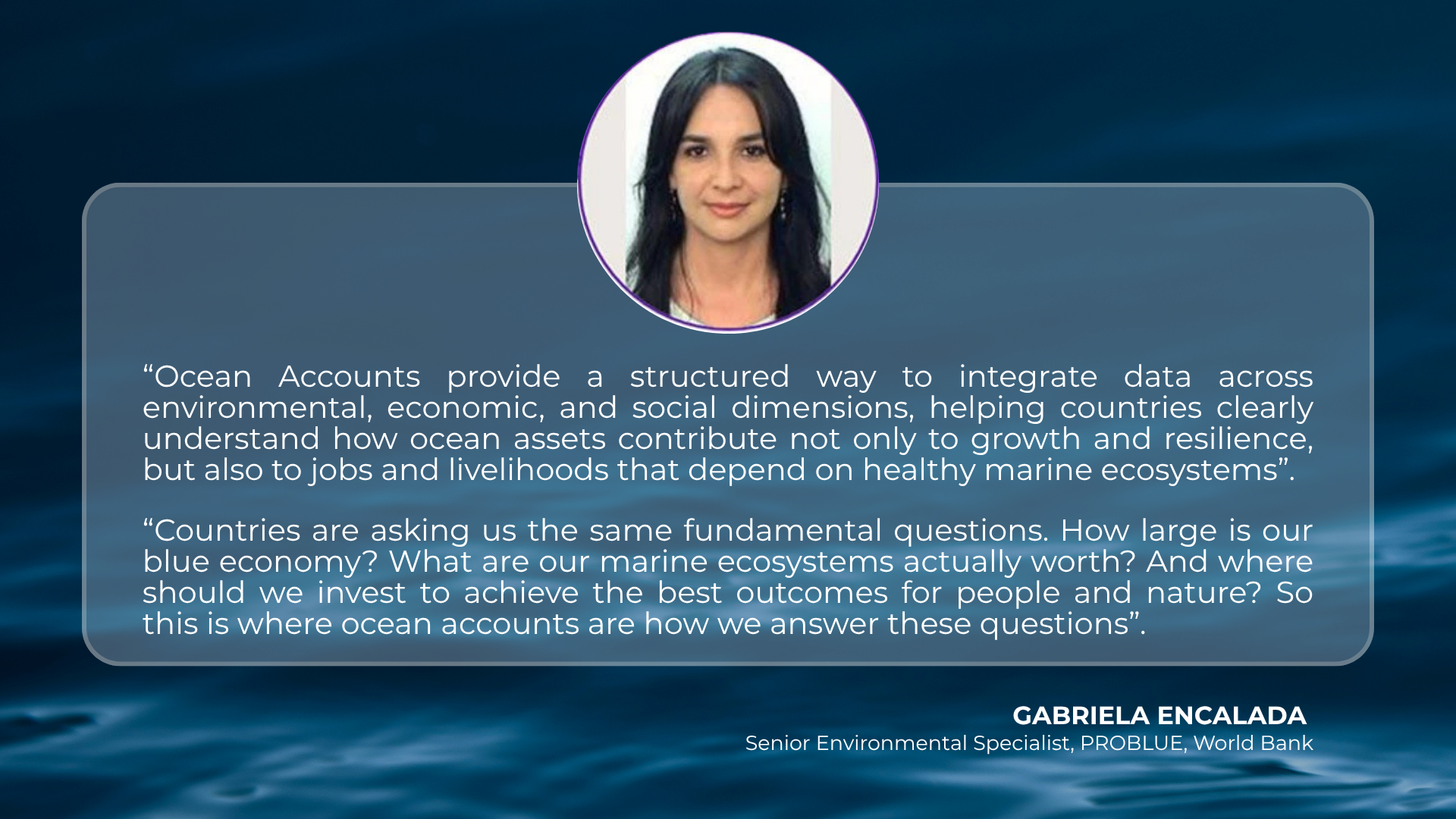
Gabriela Encalada, Senior Environmental Specialist at PROBLUE, World Bank, began by providing a general explanation of PROBLUE, the bank's ocean program. She stated that it is a "multi-donor trust fund that supports countries to protect and use ocean and coastal ecosystems in a way that supports economic growth, jobs, and environmental sustainability by building the foundations of a sustainable and inclusive blue economy."
She noted that Ocean Accounts provide a structured way to integrate data across environmental, economic, and social dimensions, helping countries clearly understand how ocean assets contribute not only to growth and resilience, but also to jobs and livelihoods that depend on healthy marine ecosystems.
“Countries are asking us the same fundamental questions. How large is our blue economy? What are our marine ecosystems actually worth? And where should we invest to achieve the best outcomes for people and nature? So this is where ocean accounts are how we answer these questions and with evidence rather than just assumptions. From fragmented decision-making to more integrated and strategic planning.”
Don't miss a single detail of this important conversation on ocean accounts! We invite you to watch the full video of this session. Sessions I and II are also available here.