
Business Of The Ocean Coordination Mechanism - MEETINGS, EVENTS, KEY DOCUMENTS
INTERIM UPDATES FROM THE SECRETARIAT
Date of publication: June 30, 2026. Access the presentation at the following link:
Business OF THE STEERING GROUP
Overview of the Steering Group (incl. SG Rules of Procedures)
The Steering Group (SG) of the Wider Caribbean Ocean Coordination Mechanism (OCM) is composed by representatives of the States and Territories that have signed the OCM MoU
At its First Regular Meeting (SGM1.2, 6 August 2025), the OCM SG adopted the “Steering Group Rules of Procedure” (RoP) document (v1.5), noting that the SG RoP may be revised or further complemented if a request for such is supported by a simple majority of the membership.
The Rules of Procedure (RoP) document can be accessed here.

As of June 30, 2026, 23 States/Territories have signed the Memorandum of Understanding (MoU), that creates the OCM,affirming their commitment to more integrated ocean governance. *Additional elegible member countries and organizations,highlighted in gray, are invited to consider joining the OCM at their earliest convenience.
The activities of the Ocean Coordination Mechanism are financially suported by the UNDP/GEF/UNOPS PROCARIBE+ Project.
The Chairmanship and Vice Chairmanship of the OCM Steering Group is currently exercised by respectively Grenada and Panama.
Through Decision oSGM1.D8.1, the SG calls for all SG Members to submit their OCM SG Focal Point(s)/Representative(s) nominations to the Secretariat (info@procaribeplus.org) and to help the Secretariat in keeping this information up-to-date.
The list of nominations currently registered with the Secretariat can be accessed here.
The online OCM SG Decision Tracker can be accessed here.
An overview of the representation roles exercised by the SG and EG Chair and the Secretariat can be accessed here.
Text last updated: 5 November 2025.
Business of the EXECUTIVE GROUP
Overview of the Steering Group (incl. EG Procedural Guidelines)
The Executive Group (EG) of the Wider Caribbean Ocean Coordination Mechanism (OCM) comprises representatives of the Intergovernmental Organisations (IGOs) that have signed the OCM MoU.
At its First Regular Meeting (EGM1, 24 February 2025), the OCM EG adopted the “Executive Group Procedural Guidance” (PG) document (v1.0), noting that the EG PG may be revised or further complemented if a simple majority of the membership supports such a request.
The Procedural Guidance document can be accessed here.

As of June 30, 2026, 9 IGO's have signed the Memorandum of Understanding (MoU), that creates the OCM,affirming their commitment to more integrated ocean governance. *Additional elegible member countries and organizations,highlighted in gray, are invited to consider joining the OCM at their earliest convenience.
The activities of the Ocean Coordination Mechanism are financially suported by the UNDP/GEF/UNOPS PROCARIBE+ Project.
OCM WORK PROGRAMME
__________________________
As part of its contributions to supporting the OCM during its initial years of operation, a number of Outputs that will help the OCM advance on its mandate -and at the same time support the mandates of the OCM's member IGOs- have been incorporated in the PROCARIBE+ Project Results Framework. Consequently, funding to help the OCM (and its collective membership) deliver these Outputs has been included in the PROCARIBE+ Project Budget. These PROCARIBE+-supported Outputs now constitute the core elements of a preliminary 2025-2028 OCM Work Programme, approved by the OCM Steering Group (countries) and Executive Group (IGOs) in 2025.
OCM Work Programme
The OCM Work Programme takes initial reference from a 2-pronged conceptual approach promoted by the GEF - consisting of the development of a “Transboundary Diagnostic Analysis” (TDA) which is then to inform the development of a regional “Strategic Action Programme” (SAP). A first, regional-level* iteration of this approach had been facilitated through 2 GEF-funded, predecessor projects of PROCARIBE+, namely the CLME (2009-2014) and CLME+ (2015-2021) Projects.
The OCM Work Programme now explicitly acknowledges that, in order for the Wider Caribbean region to adopt this methodolgoy for the long-term, and for it to be "owned" by the OCM membership, a modified, adapted approach - necessary to ensure that the methodology becomes adjusted and “regionalized” in the most meaningful and sustainable way- will have to take into account the reality and particularities of the Wider Caribbean, and build on the region’s formal, native ocean governance mechanisms and processes that are already well established, or currency under development.
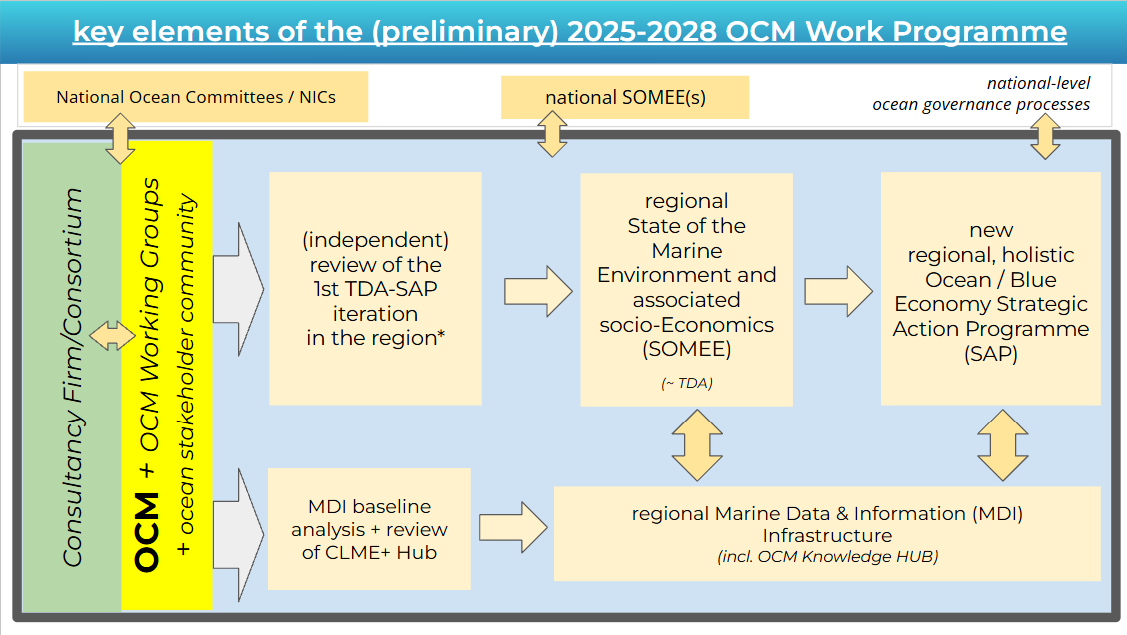
The core elements of the OCM Work Programme are
a periodic, standardized, collaborative, integrated “State of the Marine Environment and associated socio-Economics” (SOMEE) reporting mechanism, (to be) formally adopted by the OCM (i.e., what is to become the region’s own interpretation/adaptation of the GEF-promoted “TDA” approach, compatible with/supportive of and/or complementary to the already existing assessment processes).
a first version/the first edition of such report.
a new regional "Resilient Blue Economies" Strategic Action Programme (SAP) on the marine environment - or an equivalent strategic tool or guiding document (or set of documents), (to be) politically endorsed at the regional level (note: this requires similar considerations as those mentioned for the SOMEE mechanism)
a Blueprint for a regional Marine Data and Information (and Knowledge) Infrastructure (MDII blueprint), suited for supporting integrated ocean governance in the Wider Caribbean (and the region’s adaptation of the cyclical TDA-SAP approach), formally endorsed or adopted by the OCM.
and, as part of an “early implementation” effort under the latter: an online OCM Knowledge Hub (or network of Hubs), as one of the pillars of the MDII, (to be) formally adopted by the OCM.
Additionally, a Sustainability Strategy for the OCM will need to be developed and adopted, focussed on the OCM’s unique added value, and ensuring its successful continuity in time. The Strategy is to give consideration to an initial performance evaluation of the OCM, and of any ensuing recommendations.
The overarching timeframe for the delivery and adoption/endorsement of the aforementioned outputs is to be aligned with the implementation period of the PROCARIBE+ Project. The project end date as currently on paper at the time of writing is early May 2028.
The approach (to be developed through consultancies, and with the support of the OCM Working Groups) towards delivering these outputs needs to duly consider related experiences from the (recent) past, both within the Wider Caribbean region and beyond/globally, and should, as much as possible, build on, harness and further strengthen, and/or complement existing related and relevant efforts currently undertaken or planned by (prospective) OCM members, and other relevant entities and initiatives.
Consequently, the work to be undertaken by or through the OCM is to avoid the duplication of efforts, and is to be geared towards facilitating, integrating, adding value and/or the complementation of existing efforts, and should as much as possible be an enabler for the fulfilment of the OCM member’s mandates rather than a source of substantial additional burden.
More detailed draft ToRs that are meant to guide the implementation of the OCM Work Programme can be found here.
OCM WORKING GROUPS
__________________________
The mission of the OCM Working Groups (WGs) is to assist and support the OCM in the execution of the OCM Functions listed under MoU Articles VI-VIII.
The OCM working groups support the execution of its core and (as applicable) complementary functions, including by supporting the advancement of OCM Work Programme implementation.
Online Collaborative Workspace- Monday.com
OCM Working Group members can access the online monday.com collaborative workspaces of the WGs using the following links:
MDI WG Activities- Monday Board
SOMEE WG Activities- Monday Board
Key OCM Documents and Products
__________________________
Representation Functions exercised by OCM Chairmanship and Secretariat
__________________________
OCM RELEVANT MEETINGS AND EVENTS
__________________________
STATUS UPDATE: Wet OCM MOU Signature Pages at the OCM Secretariat
__________________________

The Who Is Who of the OCM
__________________________
OCM Special Events
__________________________